
Artificial intelligence is transforming companies and the world of work. This raises a new question for event planners: Which AI topics now belong at conferences, panels, and corporate events?

AI in business has evolved from a future-oriented topic to a concrete business challenge. Companies are exploring AI applications, automating more and more processes, developing new products, and simultaneously asking themselves what skills their employees will need in the future.
The development is rapid. According to a representative Bitkom survey from September 2026, [number missing] are now [missing information]. 57 percent of companies with 20 or more employees in Germany are using artificial intelligence.. A further 38 percent are planning or discussing its use. 91 percent consider AI to be the most important technology of the future. (Source: Bitkom.org)
This trend is also reflected at events. AI in business is becoming a topic for economic congresses, specialist conferences, panels, management events and internal company events.
This presents a great opportunity for event organizers. Because the most exciting questions now revolve less around what artificial intelligence can fundamentally do. What's interesting is..., what AI is specifically changing for companies, employees and entire industries.
Artificial intelligence now affects far more than just IT departments.
Management is addressing the strategic importance of AI. Departments are increasingly implementing its applications. HR is developing new competency profiles and training programs. Marketing, sales, customer service, knowledge management, and production are testing new processes.
Current figures show how widespread AI use has become. Companies are using AI in areas such as customer contact, marketing and communication, internal knowledge management, production and controlling, and increasingly in their own products and services. AI agents are also gaining more attention: According to Bitkom, 11 percent of companies that already use, plan to use, or are discussing AI are already implementing it, while another 29 percent are planning to do so. (Source: Bitkom.org)
With increasing usage, new questions also become relevant:
Which company data may be processed in AI systems?
What legal requirements apply to an application?
Who bears responsibility within the company?
How transparent do AI-generated content need to be?
And how can employees be trained safely in the use of the new applications?
For events, this means: AI in business can be discussed from very different perspectives.
That's precisely what makes the topic interesting for me as a moderator. Depending on the event, it can be about technology and specific applications, about leadership and the world of work, or about how companies can develop a sustainable strategy from individual AI projects.
Anyone planning a conference, panel discussion, or corporate event on artificial intelligence today can approach the topic from a variety of perspectives. It becomes particularly interesting where technological developments have concrete effects on companies and the people within them.
Many employees have already gained their first experiences with generative AI. For companies, this marks the beginning of the next step.
How do individual applications become functioning processes? Which tasks are suitable for AI? What data and systems are needed? And where does the technology actually create added economic value?
Companies are currently using AI in a wide variety of areas. At the same time, 59 percent of companies using AI state that they are not yet fully exploiting the technology's potential, while another 28 percent consider their use to be rather limited.
For a AI Event for Companies This gap between usage and actual integration offers plenty of material.
Instead of talking about abstract future scenarios, companies can use the stage to demonstrate which applications already work, what prerequisites were necessary, and how AI has evolved from individual experiments to an integral part of corporate strategy.
This also includes the technical foundation. Data must be available and usable, systems must be interconnected, and responsibilities for AI applications must be clearly defined. This becomes particularly tangible with AI agents: As systems increasingly take on tasks autonomously, companies must define which data they can access, which decisions they are allowed to make, and at what points human involvement is required.
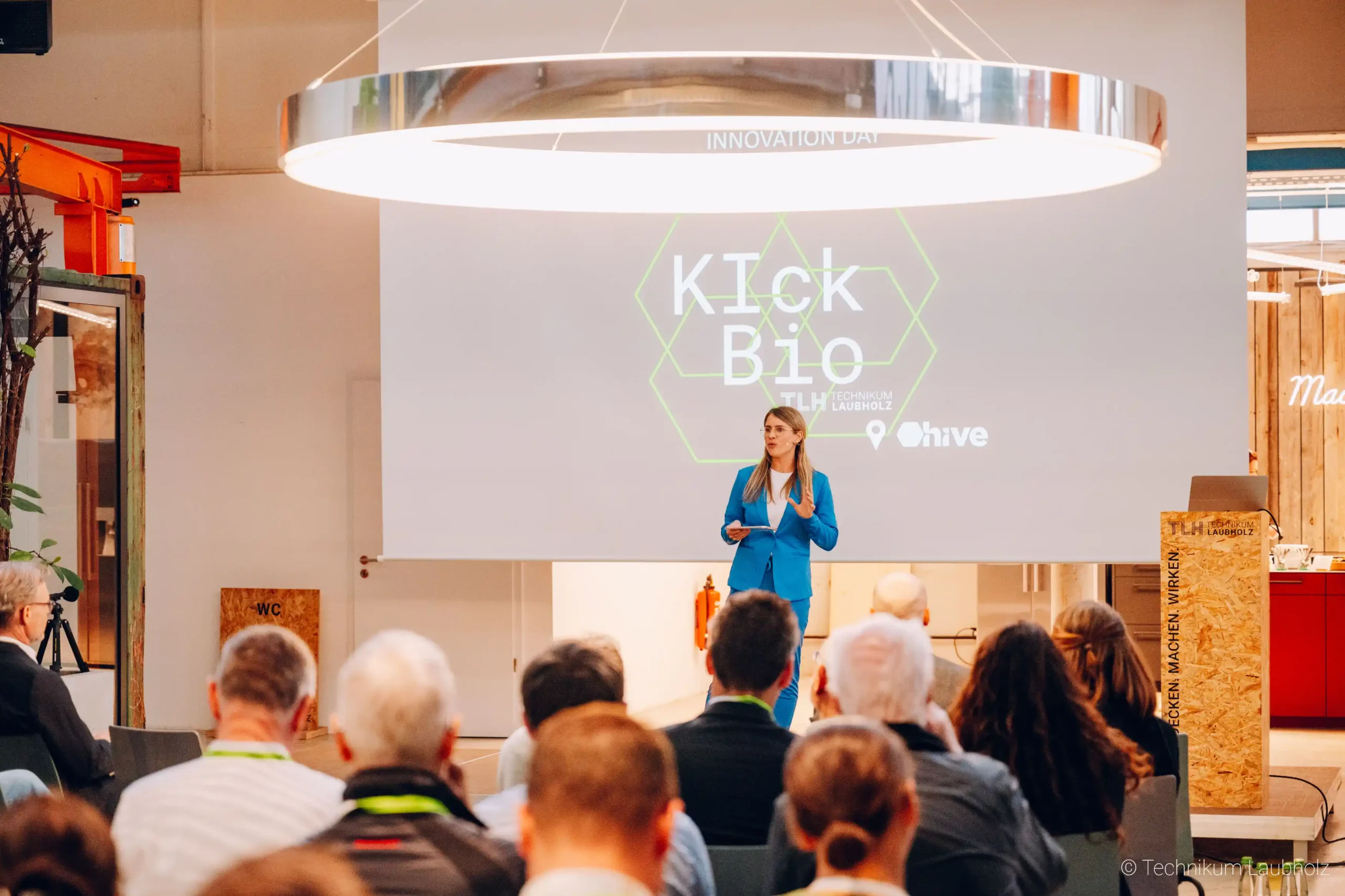
AI in business is also changing people's work. This involves specific tasks and processes: Which tasks can be supported by AI? How are roles changing? Which skills are becoming more important? How must leadership and collaboration respond to this?
This perspective is particularly relevant for internal company events, management conferences and HR events.
Because technological change within a company works in conjunction with the people who work with the new applications. Accordingly, the question of... AI expertise onto the stage.
Currently, 66 percent of the companies surveyed by Bitkom rate their employees' AI skills as low. At the same time, 70 percent now offer further training in AI. Among companies that are already using AI, this figure is as high as 91 percent.
This opens up a field of topics for event organizers that directly links technology with personnel development and corporate culture.
With the practical application of AI, data protection and legal frameworks are moving more into focus. This is also reflected in the experiences of companies: 66 percent of companies using AI cite data protection requirements as a challenge, and 56 percent cite legal uncertainty. 45 percent are concerned with the question of how company data can be protected. (Source: Bitkom.org)
At the same time, the European AI Act establishes new requirements for the use and provision of certain AI systems. Since August 2, 2026, further transparency obligations have been in effect, among other things. Depending on the type and use of a system, different requirements apply to providers and operators.
This leads to very specific issues for companies:
What data may be entered and processed in AI applications?
How can sensitive company and customer data be protected?
Which requirements of the AI Act affect the systems used?
When must AI-generated or manipulated content be made transparent?
What internal guidelines do employees need for the use of AI?
What role do copyright and usage rights play in AI-generated content?
Who takes responsibility for the selection, implementation, and control of an AI application?
This interplay of technological possibilities, data protection, and legal requirements offers ample material for discussion, especially at panels and conferences. As AI usage increases, so does the challenge of establishing clear frameworks for its application within companies.
The more companies use artificial intelligence, the more interesting the question becomes: what does AI actually bring?.
Recent company surveys already provide initial answers. According to Bitkom, two-thirds of companies using AI report an improved competitive position. 48 percent have significantly accelerated internal processes, 45 percent see a measurable contribution to business success, and 36 percent have developed new products or services with the help of AI.
I find these experiences particularly interesting for events. Instead of just talking about the possibilities of AI, companies can demonstrate, what has already changed concretely as a result of their efforts:
Which processes work differently today?
Where does AI actually save time?
What new products or business models have emerged?
What experiences have employees had with the applications?
What is needed for an AI project to become an integral part of the company?
Artificial intelligence now touches so many areas that an event needs a clear focus. For event planners, the first question is therefore: which topic is relevant to their audience?.
Depending on the event, very different priorities can be the focus:

How can AI be meaningfully integrated into a company?
How do tasks, roles, and collaboration change?
What knowledge do employees and managers need?
Which applications are already working?
Which processes can be redesigned?
How can AI applications be safely integrated into existing processes?
How can clear rules and responsibilities for AI be established?
What new products and services will be made possible by AI?
For a business conference, strategy and competitiveness may be of interest, while for an internal company event, the focus is more on the impact on work processes and employees.
The industry also influences the discussion. An industrial company deals with different AI applications and data than a financial services provider, a retail company, or a healthcare company. Therefore, when designing an event, it's worthwhile to break down the broad topic of AI into the specific questions of the respective audience.
The choice of focus also determines which perspectives should be represented on stage. Depending on the topic, for example, management, technology, science, HR, or specialist departments can contribute their experiences and assessments to the discussion. For questions concerning data protection, regulation, or the AI Act, legal and regulatory perspectives may also be relevant.
Artificial intelligence is developing rapidly. Anyone moderating discussions on this topic must understand the fundamental concepts and be able to follow and contextualize current developments.
AI and digitalization have been among my professional focus areas as a moderator for several years. I have already attended numerous events and expert discussions in this field and continuously deepen my knowledge through seminars and professional development courses. At the same time, I am constantly engaged with new applications, technological developments, and the economic and social issues surrounding artificial intelligence.
Each event requires specific preparation for the respective topic. I research the participating companies and institutions, familiarize myself with the professional backgrounds of my interviewees, and identify which developments and perspectives are particularly relevant to the audience.
In doing so, I also pay attention to the different perspectives my interviewees bring. For example, an AI panel might include technology providers, user companies, academics, executives, or experts in data protection and regulation. Connecting these perspectives and asking follow-up questions at crucial points is, for me, part of good content preparation.
My journalistic background helps me to quickly grasp complex relationships and develop questions that move a conversation forward in terms of content.
Especially with a topic that is developing as rapidly as artificial intelligence, continuous professional engagement is, for me, an integral part of preparing for a moderation.

Whether it's a congress, panel discussion, or corporate event: I moderate events related to Artificial intelligence, digitization and digital transformation and I immerse myself intensively in the respective topics, companies and conversation partners.
They are planning an event to AI in business and are looking for a moderator who is knowledgeable about the topic and can ask targeted follow-up questions even in complex discussions?